In March 2026, Ahrefs analyzed 863,000 keyword search-result pages and 4 million URLs cited in Google AI Overviews. Only 37.1% of the cited URLs also ranked among the top 10 standard organic links for the same query.
In other words, the map and the compass are beginning to disagree.
A brand can spend years learning how to become visible on the familiar map of search, including rankings, keywords, backlinks and authority, only to enter AI discovery and find that the landmarks have moved.
We are seeing a version of that shift in independent jewelry.
At Found & Form, we study how independent brands get discovered across search, editorial coverage, creators, communities, commerce and, increasingly, AI recommendations. Our Discovery Studies examine the trails that lead people to individual brands. Separately, we ran an exploratory AI discovery experiment using five fresh shopping prompts.
Across 36 recommendation slots, ChatGPT surfaced 32 different jewelry brands. Only four appeared across more than one shopping intent.
Change the question, and the map changed with it.
That is what makes the emerging discovery landscape so interesting. A brand can be highly visible when someone already knows what to search for and nearly invisible when an AI system is asked what to recommend. Another can have modest conventional search visibility yet be interpreted as an unusually good answer to a specific aesthetic, material or shopping request.
Being searchable and being recommendable are no longer necessarily the same thing.
And the gap between them may tell us more about the future of brand discovery than either metric does on its own.
The search problem was already visible
The independent brands in our Discovery Studies are not unknown companies.
Castro Smith has been covered by British Vogue, The Telegraph, The Times, Wallpaper*, Dazed, i-D and other major publications. Its work has entered institutional and cultural channels that most independent jewelers never reach. Yet its U.S. organic search traffic has remained at roughly 700 to 840 estimated visits a month for most of the past two years.
Malka Jewelry has a different problem. Its estimated organic search traffic from Israel has generally remained between about 7,400 and 8,400 visits a month for the past two years, and about 74% of its traffic is navigational brand search. People who already know Malka can find it. People searching for the services and products that distinguish it are much less likely to.
Nana Bijou built extraordinary marketplace proof: 20,638 Etsy sales over 16 years, while its independent site receives only about 270 estimated U.S. organic visits a month.
Different brands. Different discovery systems.
The common problem is that conventional search often captures existing recognition better than it creates new recognition.
That matters because an AI recommendation begins somewhere else. The shopper does not necessarily know which brand to type.
Then we asked ChatGPT to choose brands
In September 2026, Found & Form opened five fresh, logged-out ChatGPT conversations and asked five different independent-jewelry shopping questions. We did not regenerate responses, correct the system or ask follow-up questions. We recorded the first response.
The prompts represented broad discovery, under-the-radar discovery, a dark or slightly Gothic aesthetic, solid gold with black diamonds, and a $500-$2,500 purchase-intent query.
Across the five prompts, ChatGPT filled 36 named recommendation slots with 32 unique brands. Only four brands repeated across different shopping intents: WWAKE, Sofia Kaman, Bario Neal and Automic Gold.
There was no stable top ten. Changing the shopper's intent changed the brands.
Case 1: ARTËMER and aesthetic legibility
When the request became “unusual fine jewelry with a slightly Gothic or dark aesthetic,” ARTËMER appeared first.
That is useful because “Gothic” is not simply a product category like “diamond earrings.” It is an interpretation.
An AI system had to connect a brand's products and wider identity with an aesthetic concept contained in the shopper's request. The result suggests a different kind of discovery question: not only whether a page ranks for the phrase a shopper typed, but whether enough information surrounds a brand for a system to understand that it belongs in an aesthetic.
Case 2: Maya Geller and product-level understanding
The clearest example in the experiment came from an even narrower request: independent designers making interesting solid-gold jewelry with black diamonds.
Maya Geller appeared first, and ChatGPT displayed four Maya Geller product cards.
That creates at least two layers of AI visibility. Brand visibility means the assistant knows the company belongs in the answer. Product visibility means the system can connect specific products to the shopper's request strongly enough to surface them in the shopping experience.
For ecommerce brands, the second may ultimately matter more.
Case 3: the brands that traveled across intent
WWAKE, Sofia Kaman, Bario Neal and Automic Gold each appeared in more than one of the five prompts. Most brands appeared only once.
Why did those four travel? Our experiment cannot answer that conclusively. It was exploratory, not a controlled ranking study.
But repetition gives us something useful to investigate. A brand that can be interpreted as relevant to multiple shopping intents may possess a particularly legible identity across the web: products, materials, positioning, editorial descriptions, retailer copy and customer language reinforcing one another.
That hypothesis is more interesting than asking whether a company “ranks in ChatGPT.” AI discovery does not appear to be a single ranking. It appears to be contextual retrieval.
The Discovery Gap
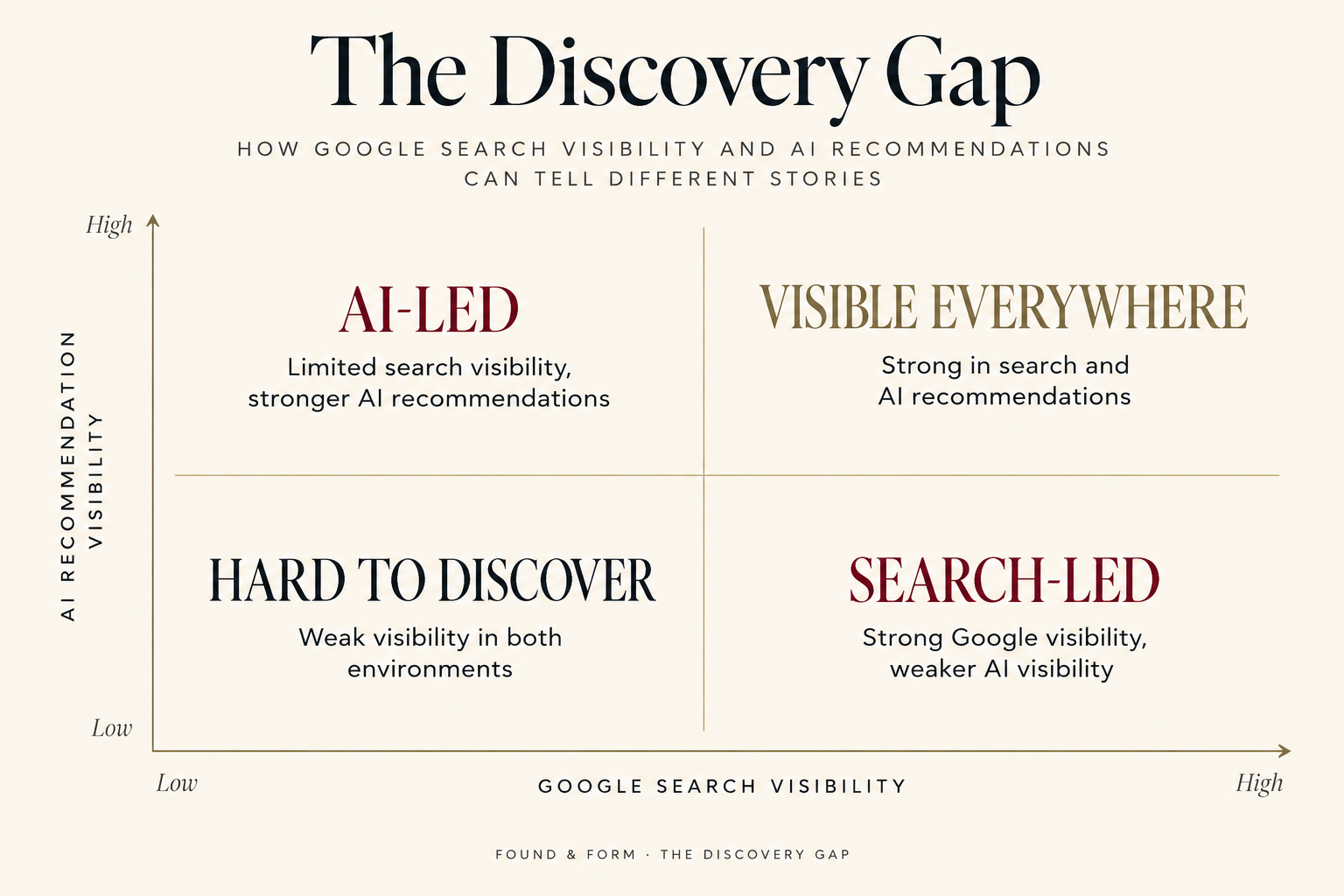
Imagine two axes: traditional search visibility horizontally and AI recommendation visibility vertically.
That creates four discovery states: Visible Everywhere; Search-Led; AI-Led; and Hard to Discover. The purpose is not to award brands another score. Instead, it is to find the gap, because the gap tells us where discovery behaves differently.
What our data does and doesn't show yet
There is an important limitation here. The Found & Form Discovery Studies and our five-prompt AI experiment are not yet a matched dataset.
The Discovery Studies contain deeper Google, backlink, editorial and discovery research on a growing set of brands. The AI test sampled 32 brands across five recommendation prompts. We therefore cannot claim that a specific level of Google visibility causes or fails to cause AI visibility. That requires testing the same predefined universe of brands across both environments.
But the evidence already establishes something useful. Traditional search visibility varies dramatically even among successful independent brands, and AI recommendations vary dramatically when shopper intent changes. Treating either system as a static leaderboard misses what is happening.
Accidental AI discoverability
There is another reason we are interested in this gap.
While researching AI discovery, we heard from a company whose product appeared to be understood by AI systems despite the company reporting no deliberate AI-search optimization. No special strategy. No attempt to “rank in ChatGPT.” The systems appeared to have figured out what the product was anyway.
We have started calling this accidental AI discoverability.
If a brand becomes recommendable without consciously optimizing for AI, what made it legible? Clear product descriptions? Consistent category language? Editorial coverage? Retailer descriptions? Customer conversations? Structured product information? A combination of all of them?
Rather than beginning with a list of supposed AI-ranking tactics, we can work backward from brands already being understood.
A brand has to be understandable before it can be recommendable
Luxury branding often rewards implication. A beautiful photograph and a sentence like “Objects carrying memory, ritual and time” may communicate perfectly well to a human visitor. But it provides very little categorical information.
Compare it with: “Hand-engraved signet rings and sculptural jewelry made in recycled 18K gold.” The second sentence tells a machine and a shopper considerably more.
What does the company make? What materials does it use? What techniques define the work? Which product categories does it belong to? What makes it different? Those answers do not require ugly SEO copy. They require clarity.
Search keywords flatten intent. AI prompts expand it.
A Google shopper might type “gold signet ring.” An AI shopper can say: “I'm looking for a substantial solid-gold signet ring from an independent designer. I want something unusual rather than minimalist, and I'd rather buy from a smaller brand than a major luxury house.”
The second request contains material, product, aesthetic, company-size and positioning signals simultaneously.
That is why AI recommendation visibility cannot be measured adequately with one generic prompt such as “best jewelry brands.” The question is not simply “Does ChatGPT know my brand?” It is “What does ChatGPT understand my brand to be relevant for?”
Measure the disagreement
Choose several commercially meaningful categories. Record traditional search visibility for each. Then translate those searches into realistic recommendation prompts.
Run the same predefined prompts consistently. Record appearance, prominence, relevance and accuracy. Then compare those observations with search visibility.
The most interesting result may be the disagreement. A brand visible in Google but absent from relevant AI recommendations has one discovery problem. A brand that repeatedly appears in AI recommendations despite limited category-search visibility has another. And a brand that appears prominently for the wrong reasons has a third.
Don't optimize for AI before understanding why AI found you
The rush to AI optimization is understandable. But independent brands should be careful not to replace one oversimplified ranking obsession with another.
Our early research suggests something more complicated. In five prompts, 32 different jewelry brands appeared. Changing an aesthetic changed the recommendations. Changing a material changed them again. One highly specific query surfaced not just a designer but four of its products. And some brands crossed multiple intents while most appeared only once.
The web is no longer simply deciding which page should rank.
Increasingly, machines are also deciding: Which brand belongs in this answer?
Understanding why may become one of the most important discovery questions for independent brands.